Complete Guide to Marriage Biodata Format: Create Professional Biodata in 2026
Learn how to create a perfect marriage biodata with our comprehensive guide. Discover the best biodata format, essential sections, and professional tips for Indian matrimony.
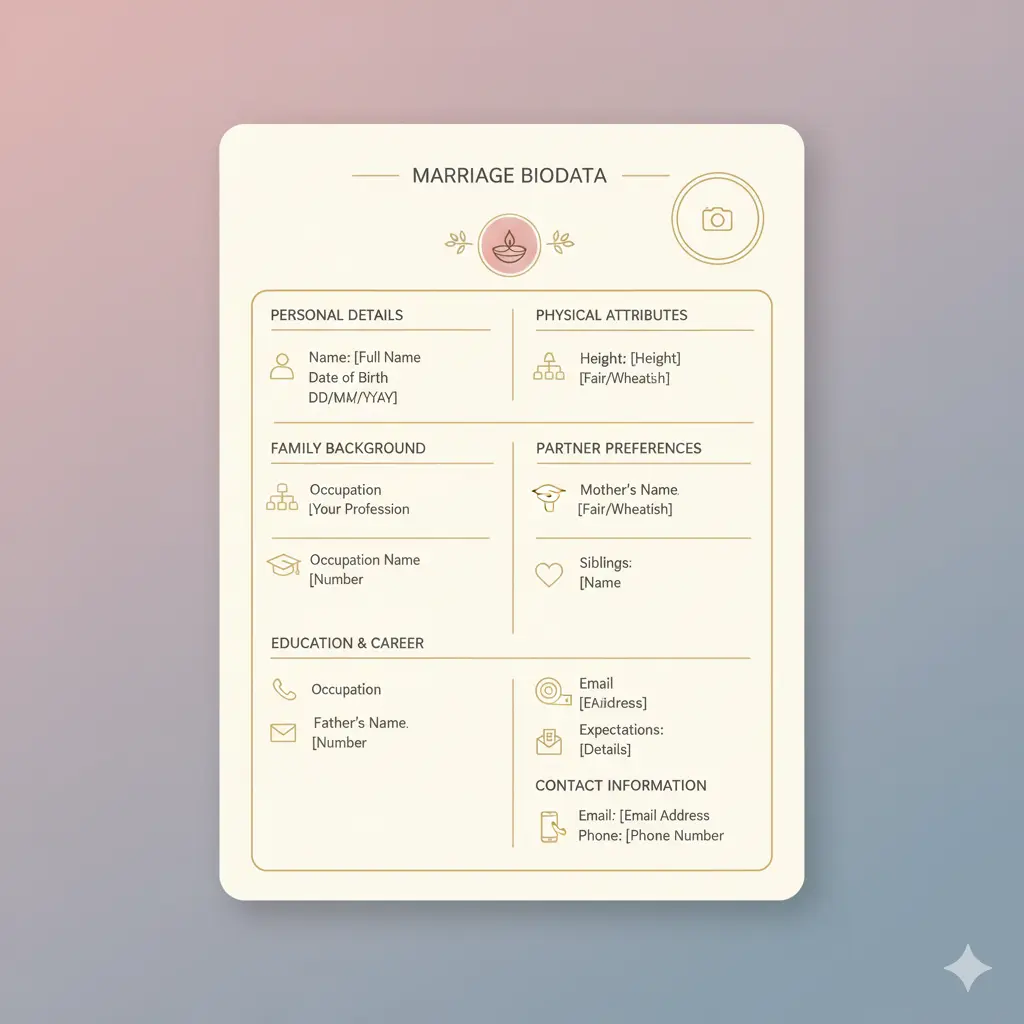
Entering the arranged marriage process begins with one foundational step: creating your marriage biodata. A well-crafted matrimonial profile serves as your introduction to prospective partners and their families. It is not just a list of facts; it is an organized summary of your life, values, and background. Understanding the proper marriage biodata format can significantly improve how your profile is received.
The Core Structure of a Modern Biodata
A standard matrimonial biodata should be clean, organized, and easy to read. Prospective families often review dozens of profiles, so clarity is key. The most effective format generally follows a logical hierarchy of information, starting with the individual and expanding to the family background.
1. Personal Information and Identification
The top of your biodata should immediately state who you are. This section must include your full legal name, current age, exact date of birth (DOB), and height. Height is a standard metric required in traditional matchmaking and should be stated clearly. Include your religion, caste, and sub-caste (or explicitly state "Caste No Bar" if applicable). Finally, add your current marital status (Never Married, Divorced, Annulled, or Widowed) and your primary spoken/mother tongue.
2. Astrological Details (Optional but Common)
If your family strictly follows Vedic astrology or Kundli matching, this section is mandatory. To allow families to run compatibility checks independently, provide your exactly calculated Time of Birth (TOB) and Place of Birth (POB). Additionally, include specific astrological markers such as your Gotra, Rasi (Moon Sign), and Nakshatra (Birth Star). If you have any specific doshas, like Manglik dosha, it is generally advised to state it here so expectations are clear from the beginning.
3. Educational Background
Start with your highest degree and work backward. You do not need to list high school grades unless they are exceptionally notable. Be specific about your degrees and the institutions you attended, especially if they are highly regarded universities or colleges.
Example: "Master of Science in Information Technology, IIIT Bangalore (2020)"
4. Professional Career and Income
Your career section should outline your current role, your employer (if comfortable sharing), and your location of work. A brief, one-sentence description of your responsibilities can add great context. While declaring annual income is optional, many traditional families expect to see an approximate salary bracket to gauge financial stability and lifestyle compatibility.
5. Family Background
Marriage in many cultures is the union of exactly two families. Your family section should list your father's full name and precise occupation (e.g., "Retired Government Officer, State Bank"), your mother's name and occupation, and the status of your siblings. For siblings, mention if they are married and briefly state what they or their spouses do professionally. Lastly, clarify your family's native place versus your current permanent residence.
6. The 'About Me' and 'Partner Preferences' Section
This is where your personality shines. Write a short, conversational paragraph about your lifestyle, your hobbies, and what you value in life. Follow this with your expectations for a partner. Be honest about your preferences regarding their career status, willingness to relocate, dietary habits, or educational background.
Formatting Best Practices
Your biodata should ideally fit on one or two pages. Use standard, legible fonts like Arial, Calibri, or Helvetica, and avoid overly stylistic, cursive fonts that are hard to read on mobile screens. A clean layout with defined margins and bullet points is far superior to dense blocks of paragraphs.
If you prefer not to format spacing and tables manually from scratch, utilizing an online biodata maker can be a helpful way to automatically organize your information into a neat, professionally aligned PDF ready for sharing.
Create Your Marriage Biodata
Ready to create your professional marriage biodata? Use our free biodata maker to create stunning biodata in minutes. Explore our biodata templates and start your matrimonial journey today at BiodataMaker.utilcube.com.
Create Your Marriage Biodata in 2 Minutes
Use our free biodata maker to create professional marriage biodata instantly. No design skills required!
Create Free Biodata NowTrusted by 50,000+ families • 100% Free • Instant Download
Related Articles
Best Biodata Templates for Indian Marriages: Free Professional Designs
Choosing the right design for your matrimonial profile is crucial. Learn about the different types of biodata templates available and how to select one that matches your personality and cultural background.

How to Write a Perfect Marriage Biodata: Step-by-Step Guide 2026
Writing a marriage biodata requires balancing hard facts with genuine personality. Learn our step-by-step guide to writing a matrimonial profile that accurately reflects who you are and what you want.
Arranged Marriage vs Love Marriage: Complete Comparison Guide 2026
The concepts of arranged marriage and love marriage are evolving. Explore the real differences, practical advantages, and unique challenges of both approaches to finding a life partner in modern society.